You fall asleep thinking, okay, not bad. The couch is clear. The counters are mostly visible. The place has that quiet Pinterest calm where nothing screams at you. It’s not perfect, but it’s decent. You exhale. Lights out.
Then morning happens.

Breakfast detonates across the kitchen. Backpacks unzip like feral animals. One shoe goes missing. Keys vanish into some parallel universe. Yesterday’s mail, which you definitely dealt with, somehow respawns on the counter. By the time you’re pulling on your coat, you’re stepping over the same chaos you swore you handled the night before.
It’s like the house reset itself overnight. Or worse—it actively worked against you.
That low-level frustration isn’t about laziness or discipline. It’s the quiet tax you pay when a home doesn’t have a clear rule for where everyday things actually live. You tidy. The mess returns. You tidy again. Nothing sticks.

There is, however, one small rule that cuts straight through this loop. It’s almost boring in its simplicity. But once it’s in place, the mess stops boomeranging back.
The one-rule reset that stops clutter from coming back
The rule is this: everything you use daily gets one visible, easy home—and it must be easier to put away than to drop anywhere else.
Not five homes. Not “I’ll deal with it later.” One obvious spot you can find half-asleep, with one hand, without thinking.

This isn’t about hiding stuff. It’s about making the real landing spot so effortless that clutter doesn’t get a chance to spread across every flat surface. Hooks instead of drawers. Open baskets instead of closed boxes. Trays instead of “temporary” piles that turn permanent.
When that one home exists, you don’t have to try to be tidy. You just follow gravity. Your hand goes to the hook. The bag slides into the basket. The keys land in the dish. That’s why this works for exhausted parents, distracted teenagers, and guests who’ve never been in your house before. The system explains itself.
Why most homes fail at staying tidy
Watch any hallway at 6 p.m. on a weekday. Bags hit the floor. Shoes scatter like evidence at a crime scene. Coats migrate to chairs. Nobody is thinking about storage solutions in that moment. They’re hungry, tired, scrolling, or racing to the bathroom.
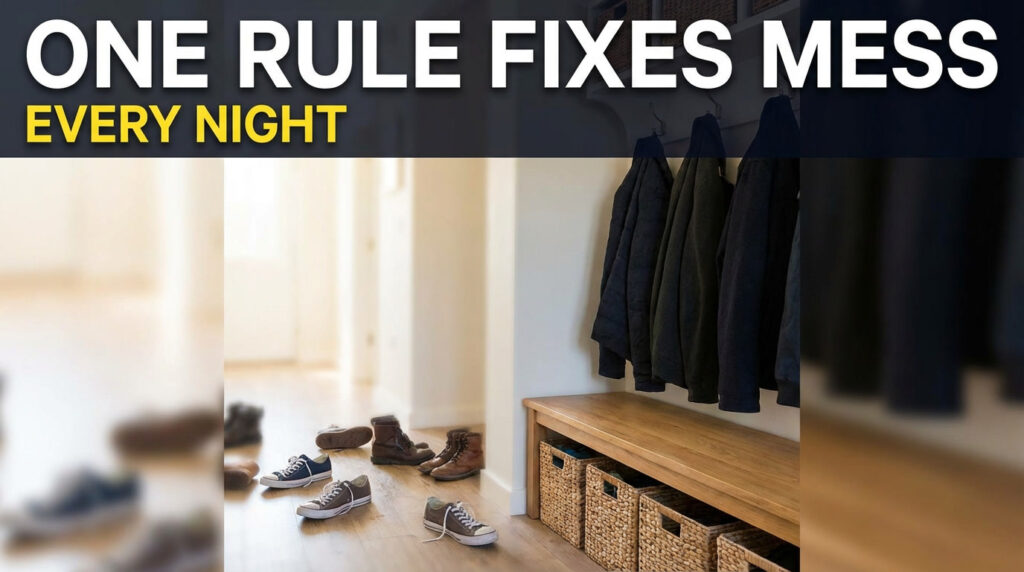
Now imagine the same scene with a long bench by the door, three open baskets underneath, and a row of hooks at eye level. No lids. No doors. No fiddly hangers. The bag lands on the bench. Shoes get shoved into a basket. Coat goes on a hook in one lazy motion. No extra decisions required.
That difference matters more than any decluttering marathon.
In a survey by the National Association of Productivity & Organizing Professionals, people consistently said maintaining tidiness felt harder than decluttering itself. The reason is simple: most homes are designed for “storage someday,” not “real life in five seconds.” There’s nowhere easy for things to land, so they land everywhere.
This rule works because it respects how humans actually behave. We don’t walk across the room, open a cupboard, find the correct box, and gently file an object away after a long day. We dump things where we are. So storage has to meet us there, not demand we become better people.
When storage is harder than dropping things, mess wins. When storage is easier, laziness becomes your ally.
The psychology behind why this sticks
Psychologists talk about decision fatigue—the way tiny choices drain us throughout the day. Where should this go? Will I need it later? Should I leave it out just in case? That’s a decision every time you touch something without a fixed home.
One obvious home removes the question entirely. The key dish. The mail tray. The laundry basket in every bedroom. Those are yes-or-no moves, not mini debates.
Once the decision disappears, the reset becomes automatic. Your evening tidy goes from half an hour of wandering to five minutes of muscle memory. You’re not inventing storage on the fly. You’re returning things to places that already exist.
That’s the real power here: less willpower, more design.
How to apply the rule room by room
Start where the mess regenerates fastest: the entrance, the kitchen, the living room. Pick five things you touch every single day—keys, bag, shoes, mail, headphones. For each one, choose one home that’s open, visible, and physically close to where it already lands.
Hang a key hook exactly where your hand naturally reaches when you walk in. Put a tray or shallow bowl on the console for sunglasses and earbuds. Drop a big, unpretentious basket next to the sofa for blankets and random toys.
Don’t worry about labels yet. Just make the “this lives here now” signal obvious.
If your bag always ends up on the floor, put a hook or peg within that same arm’s reach. If mail constantly piles up on the kitchen island, place a standing file or letter tray right there. You’re not fixing bad habits—you’re formalising them.
Soyons honnêtes : personne n’a envie de jouer à l’organisateur parfait tous les jours. Nobody dreams of carefully returning pens to a closed box in a distant cupboard after a chaotic Tuesday. So don’t build a system that demands it.
Build one that works when you’re tired, distracted, and running late.
What to avoid (even if it looks good)
The biggest mistake is creating storage that looks beautiful but requires precision. Tiny labelled boxes. Deep baskets where things vanish. High shelves that need a stretch and a prayer.
That’s how you end up with “organised” zones that last exactly two days.
Think generous instead. One big basket for “tech stuff near the sofa.” One drawer for “this month’s school papers.” One open shelf for cookbooks actually in rotation. If your system needs instructions, it won’t survive a rough week.
A London-based professional organiser put it bluntly: “A system only works if your most exhausted self can use it without thinking. Design for the version of you who comes home at 9 p.m. with takeaway and zero patience.”
Make the homes visually obvious
Add tiny visual cues so everyone gets the message without a lecture. A piece of tape with a key icon above the hook. A bright liner inside the mail tray. A contrasting basket by the door that doesn’t blend into the wall.
These cues tell the brain, this is a thing with a purpose, not just a random bowl.
Here’s what the rule looks like in practice:
| Key principle | What to do | Why it works |
|---|---|---|
| Make storage easier than dropping | Use open baskets, hooks, and trays at natural drop points | Cuts clean-up time and stops clutter from spreading |
| One item, one home | Keys, bags, mail, remotes each get a single spot | Reduces lost items and last-minute stress |
| Design for tired you | Avoid lids, high shelves, and tiny containers | Keeps the system usable on chaotic days |
The quiet shift you’ll actually feel
The biggest change isn’t visual. It’s physical.
At 10 p.m., when you glance around before bed, your shoulders don’t tense. Your brain isn’t running a silent to-do list of things you should pick up. The house feels neutral, not demanding.
On bad days, that matters more than any minimalist fantasy. On good days, it gives you back time—five minutes to reset the living room, two for the hallway, one sweep of the kitchen counter because the tray caught the chaos.
It also creates an unspoken agreement with everyone you live with: this is where things live. No lectures. No chore charts that die by week two. Just a hook that wants a coat and a basket that wants shoes.
On a tous déjà vécu ce moment où on explose intérieurement en marchant sur un jouet ou en ne trouvant pas ses clés alors qu’on est déjà en retard. This rule won’t stop life from being messy. Kids will still dump Lego. Adults will still abandon mugs in odd places. But the reset becomes fast and almost mechanical.
This isn’t about becoming a “tidy person.” It’s about removing daily friction. Less searching. Fewer low-grade arguments. More evenings where you sit on a clear sofa without staging a full clean-up first.
Start small. A key hook. A shoe basket. A mail tray. Then you’ll catch yourself asking, without really noticing: where does this actually live?
That question, asked enough times, reshapes a home. Not into a showroom—but into a place that quietly resets itself while you live your very real, imperfect life inside it.
FAQs:
What’s the simple storage rule in one sentence?
Everything you use daily gets one visible, easy home that’s closer and simpler than any other place you could drop it.
How long before this feels natural?
Most people notice a difference within a week. After two to three weeks, the new homes feel automatic.
What if my partner or kids ignore it?
Start with shared pain points like keys and shoes. Make the homes ridiculously obvious and redirect items calmly. Consistency beats speeches.