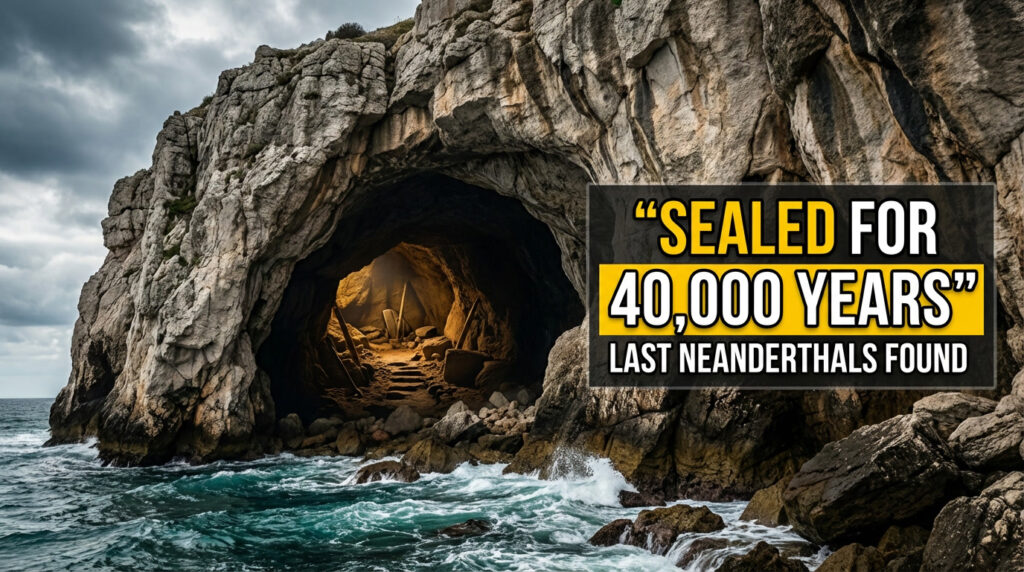
The first thing that hits you at Gorham’s Cave isn’t the archaeology. It’s the sound. Waves slapping limestone, gulls cutting across the wind, the Mediterranean breathing in and out just meters from the entrance. It feels alive. Which is fitting, because this cliffside cave complex may be one of the last places on Earth where Neanderthals lived, worked, cooked, created—and slowly disappeared.
Perched on the eastern face of the Rock of Gibraltar, this isn’t just a hole in the ground. It’s a time capsule. One that’s been quietly rewriting what we thought we knew about our most misunderstood human cousins.
A Cave That Used to Be Inland

Today, Gorham’s Cave sits right on the waterline, its mouth almost licked by the sea. But rewind the clock 100,000 years, and the geography looks very different. Sea levels were significantly lower. What’s now a dramatic seaside cliff was once a broad coastal plain, rich in game, plants, and access to marine food.
The Gorham’s Cave complex isn’t a single cave at all. It’s a cluster of four: Gorham’s Cave, Vanguard Cave, Hyaena Cave, and Bennett’s Cave. Together, they form a limestone warren carved by time and tides. In 2016, the site was formally recognized as a UNESCO World Heritage Site, cementing its global importance as a key archive of Neanderthal life.
Discovered back in 1907, the caves sat largely understudied for decades. It wasn’t until systematic excavations began in the 1980s that researchers realized just how deep—literally and historically—this place went.
No Bones, But Plenty of Life

One of the strangest things about Gorham’s Cave is what it hasn’t yielded. No Neanderthal skeletons. No Homo sapiens remains either. And yet, the evidence of human presence is overwhelming.
Layer after layer of sediment tells a story spanning nearly 100,000 years. Stone tools. Hearths. Ash. Cut-marked bones. Discarded shells. All signs point to sustained occupation long before modern humans arrived in Western Europe around 40,000 years ago.
That timing matters. It places Neanderthals firmly in control of this landscape during a period when climates were fluctuating and survival wasn’t guaranteed. And they weren’t just scraping by.
Seafood, Survival, and Smarts

For a long time, Neanderthals were painted as big-game hunters—meat-heavy diets, brute force living. Gorham’s Cave blows that stereotype apart.
Archaeologists have uncovered vast quantities of mussel shells, along with bones from fish, seals, and even dolphins. These weren’t washed in by waves. The cave’s position and sediment layers rule that out. Many of the remains show clear signs of butchery—knife marks, intentional breakage, systematic processing.
In other words, Neanderthals here were exploiting marine resources deliberately and skillfully.
That’s a big deal. Coastal foraging requires planning, knowledge of tides, and an understanding of seasonal availability. It suggests cognitive flexibility and environmental intelligence on par with early modern humans.
Scratches That Sparked a Debate
Then there are the markings.
Deep inside Gorham’s Cave, etched directly into the bedrock floor, are a series of cross-hatched lines. They’re not random. They’re deliberate, repeated, and carefully incised. Dating suggests they were made more than 39,000 years ago.
The question that lit up academic circles: are these art?
Some researchers argue they represent abstract expression—a symbolic act rather than a functional one. Others remain cautious, suggesting they could be utilitarian or accidental. But even skeptics agree on one thing: these scratches weren’t made absentmindedly.
If they are symbolic, they join a growing list of evidence that Neanderthals engaged in behaviors once thought exclusive to Homo sapiens—art, symbolism, and perhaps even ritual.
Fire, Glue, and Knowledge Transfer
If the etchings hint at creativity, the hearths in Vanguard Cave scream technical sophistication.
Researchers identified a 60,000-year-old hearth used to produce birch tar, a sticky substance created by heating birch bark in low-oxygen conditions. Birch tar isn’t something you stumble into. It requires controlled fire, precise temperatures, and a multi-step process.
Why go to all that trouble? Because birch tar is glue. It was used to attach stone points to wooden handles, improving tools and weapons.
This implies foresight, experimentation, and—crucially—the transmission of knowledge. Someone had to learn the process, remember it, and teach it. That’s culture.
The Chamber Time Forgot
In 2021, the Gorham’s Cave complex delivered one of its most tantalizing surprises yet.
Archaeologists from the Gibraltar National Museum discovered a narrow, 13-meter-deep chamber at the back of Vanguard Cave. It had been sealed by sediment for at least 40,000 years. Completely cut off. Untouched.
Inside, they found the remains of lynx, hyena, and a vulture. These animals didn’t wander in by accident. The chamber is too deep, too remote. Even more telling was the presence of a large whelk shell—an edible sea snail—carried far from the shoreline.
Once again, the simplest explanation points to Neanderthals. Transporting food, possibly storing it, or using the chamber for reasons we can only speculate about.
When sites like this remain sealed for tens of thousands of years, they offer something archaeologists rarely get: context without disturbance. A snapshot frozen in deep time.
The Last Stand of a Species?
Here’s where Gorham’s Cave really challenges the textbook narrative.
Most timelines place Neanderthal extinction at around 40,000 years ago. But evidence from Gibraltar suggests something more complicated. Radiocarbon dating indicates Neanderthals may have occupied the caves until between 33,000 and even 24,000 years ago.
That’s shockingly recent.
If true, it means small, isolated populations of Neanderthals clung on in southern Iberia long after they vanished elsewhere. Gorham’s Cave, with its mild climate, abundant resources, and strategic location, may have been one of their final refuges.
An almost idyllic place to endure the slow fading of a species.
Why Gorham’s Cave Still Matters
Gorham’s Cave isn’t just about Neanderthals. It’s about how we define humanity.
Every new layer excavated here chips away at the old caricature of Neanderthals as dim, primitive brutes. What emerges instead is a picture of adaptable, intelligent hominins capable of art, technology, and complex survival strategies.
And the work isn’t over. Excavations continue under the oversight of institutions like the Gibraltar National Museum and with international collaboration supported by bodies linked to cultural heritage protection such as UNESCO.
Standing at the cave’s entrance today, watching the sea roll in, it’s hard not to feel the weight of it all. Life lived. Knowledge shared. Extinction endured. Gorham’s Cave doesn’t just tell a story of the past. It forces us to rethink who we are—and who we nearly weren’t.