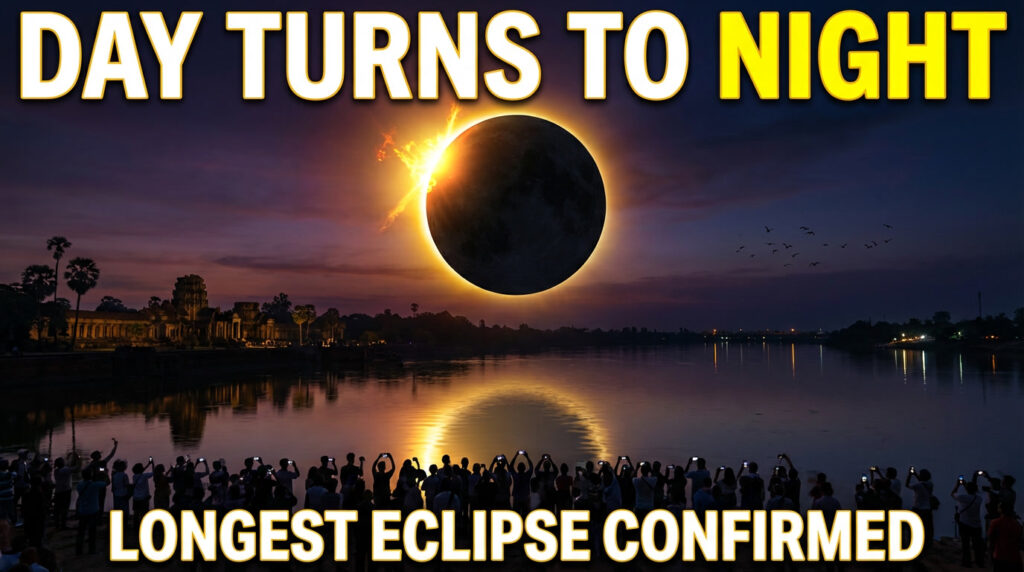
For a few rare minutes, the middle of the day will behave like midnight.
Streetlights will hum awake. Birds will stop mid-song, then circle as if someone quietly moved the rules. Office workers will drift outside with coffee cups and raised phones, squinting at a sky that suddenly forgot what time it was. The date is no longer a rumor or a headline tease. The longest solar eclipse most people alive will ever see now has a fixed place on the calendar.

Some will plan flights and hotel rooms years in advance. Others will stumble into it by accident, walking the dog or sitting in traffic, wondering why the world just dimmed and went oddly quiet. Astronomers are calling it a generational alignment. Parents are already asking schools whether classes will pause.
No screen filter will capture what it feels like when daylight switches off. And this time, the darkness will linger longer than your brain expects.
The day the sky forgets what time it is
The announcement landed with a thud in the astronomy world: on August 2, 2027, a total solar eclipse will deliver one of the longest periods of totality of the 21st century, with some locations seeing more than six minutes of full darkness. In an age of disposable news and endless scroll, this is a rare event big enough to interrupt real life.

Most total eclipses rush past. Two minutes, maybe three, and you’re left blinking, wondering if you really took it in. This one is different. The unusually long duration changes the experience from a visual trick into something physical. You feel the temperature drop. You notice the color drain from the landscape. You hear the crowd around you fall silent, not because anyone planned it, but because something ancient just took over.
The Moon’s shadow will sweep across parts of southern Europe, North Africa, and the Middle East, including areas of Spain, Morocco, Egypt, and Saudi Arabia. Tens of millions of people will sit directly under the path of totality. Many more will see deep partial phases strong enough to stop them mid-errand.
Tourism boards are already watching. Weather researchers are studying cloud patterns along the path. Amateur astronomers are quietly circling dates in red. For once, the most talked-about event of the year won’t debut on a screen. It will arrive overhead.
Why this eclipse is different from the rest

The last time many people felt this kind of collective awe was the 2017 “Great American Eclipse.” Highways turned into parking lots. Small towns became global viewing platforms. All that for just over two minutes of darkness.
In 2027, some locations are expected to experience over six minutes of totality, an eternity by eclipse standards. That extra time matters. Six minutes is long enough for the environment to react. Enough for the horizon to glow with a 360-degree sunset. Enough for cheering crowds to quiet down into something closer to reverence.
Astronomers explain the long duration with a rare alignment of distances and speeds. The Moon will be relatively close to Earth, appearing slightly larger in the sky. The Earth will be positioned so the Moon’s shadow crawls slowly across its surface instead of racing. When those variables line up, totality stretches.
Events like this don’t happen often. According to calculations published by NASA and the European Space Agency, very few eclipses this century combine such length with a path that crosses heavily populated regions and historically favorable weather windows. That’s why the word “historic” keeps coming up, even years in advance.
What people actually remember from long eclipses
Ask anyone who has stood under a long total eclipse, and they won’t start with the science. They’ll talk about strange details.
Dogs lying down as if it’s bedtime. Streetlights flickering on one by one. A sudden cool breeze. The eerie metallic tone of the light in the final seconds before darkness. In 2009, when Asia witnessed the longest eclipse of the century, factory workers stepped outside together for exactly seven minutes. Families crowded rooftops at dawn, passing homemade viewers between generations.
There’s something about an eclipse that collapses hierarchy. CEOs and delivery drivers. Kids and grandparents. Everyone looks up at the same time. In a fragmented world, that synchronized attention is rare.
Estimates suggest hundreds of millions of people will be within reach of the 2027 eclipse, with tens of millions experiencing full totality. That’s a planetary audience without a stage or a ticket.
How to experience it, not just see it
The first step is surprisingly practical: treat the date like a serious commitment. Block it on your calendar now, not as a weather note, but like a wedding or a once-only appointment.
Next, check whether you’re near the path of totality. Interactive maps from NASA and timeanddate.com already show exactly where the Moon’s shadow will travel. If you’re just outside the path, even a short trip of 50–100 kilometers can add precious minutes of darkness.
Choose a viewing spot with an open horizon. Fields, rooftops, quiet outskirts of towns. Think through the boring details early: parking, shade, seating, bathroom access. Eclipse chasers will tell you the same thing every time: discomfort ruins awe faster than clouds.
Weather is the wildcard. Studying historical cloud cover for early August can tilt the odds in your favor. Local knowledge helps. Farmers, pilots, and long-time residents often know which areas stay clearer than forecasts suggest.
There’s also a social choice to make. Do you want to be the photographer, the narrator, or the witness? Trying to do all three usually means missing the moment itself. Many experienced viewers set a camera on a tripod, hit record, and then step back.
The science, briefly, beneath the magic
A solar eclipse occurs when the Moon passes directly between Earth and the Sun, casting its narrow umbral shadow onto the surface. Totality happens only within that thin path. The duration depends on orbital speed, distances, and the angle at which the shadow moves across Earth.
For August 2, 2027, those factors align unusually well. The Moon’s apparent size will be large enough to fully cover the Sun for an extended period, and the shadow’s path will stretch slowly across regions where Earth’s curvature works in favor of longer darkness.
You don’t need to understand the equations to feel the effect. When noon turns into night, the body reacts before the brain does.
Practical magic: making those minutes count
Safety comes first. Certified eclipse glasses (ISO 12312-2) are essential for every phase when any part of the Sun is visible. Regular sunglasses are not enough. Buy early, from reputable sellers, and avoid last-minute fakes.
Comfort matters more than people expect. Bring a chair or blanket, sunscreen for the wait, and an extra layer for the sudden chill during totality. If you’re watching with kids, snacks and water can mean the difference between wonder and whining.
If you’re responsible for a group—a classroom, a workplace, a family—build the pause into the day. One teacher organizing a shared viewing can give dozens of kids a memory that sticks for life.
Soyons honnêtes : la plupart des gens ne planifient pas leur journée autour du ciel. Life will interfere. Some will catch it between meetings. Others will miss it entirely. But those who make even a small effort tend to remember it with surprising clarity.
“A long total eclipse is one of the few moments when modern humans see the universe move with their own eyes,” says an astrophysicist involved in public outreach for the event. “For a few minutes, the sky stops being a backdrop and becomes active.”
Fact Check: is this really the “longest eclipse of the century”?
The claim needs precision. The absolute longest total solar eclipse of the 21st century already occurred on July 22, 2009, lasting up to 6 minutes 39 seconds, primarily over the Pacific and parts of Asia.
The August 2, 2027 eclipse, however, is widely described by astronomers as the longest total solar eclipse most people will have realistic access to this century, with totality exceeding six minutes over land and crossing densely populated regions. That distinction is why it’s drawing such attention.
You can verify timings and paths through official sources such as NASA’s eclipse pages (https://eclipse.gsfc.nasa.gov), the European Space Agency (https://www.esa.int), and timeanddate.com (https://www.timeanddate.com/eclipse).
A shadow worth talking about long after it’s gone
When the Moon’s shadow finally races across Earth on that August day, what will linger won’t be the statistics. It will be where you stood and who stood next to you. This eclipse offers an unusually wide, slow crack in the middle of the day—a chance to step out of routine and feel the planet move.
Some will travel thousands of kilometers to chase the longest possible darkness. Others will watch from a balcony or roadside. A few will miss it and hear the stories later. The shadow won’t care. It will pass on schedule.
But for those who look up at the right moment, the memory tends to stick harder than holidays or milestones. A city dimming at noon. A shared gasp. The quiet realization that our clocks are not the only ones running.
This century will bring other eclipses. Still, this one stands apart. Not just because it’s long, but because it’s accessible, collective, and human-scaled. For a few minutes, the world will slow down enough for you to notice. Whether you step outside for it is a decision you can make now, while the Sun is still behaving normally.
FAQs:
How long will the August 2, 2027 eclipse last?
At the optimal locations along the centerline, totality is expected to exceed six minutes, with several more minutes of deep partial eclipse before and after.
Do I need special glasses the entire time?
Yes. Certified eclipse glasses are required whenever any part of the Sun is visible. Only during full totality can you briefly look without protection, and glasses must go back on immediately afterward.
Is it worth traveling for extra minutes of totality?
Absolutely. The difference between two minutes and six minutes dramatically changes how calm and immersive the experience feels.